For this blog, I watched a recent ESPN interview with Michael Sams. The video can be seen HERE . Before I talk about Michael Sams, let's first start with Rene Portland and the movie Training. The hardest thing about that movie is the respect that Rene Portland receives throughout the Women's Basketball community. The fact that she spends the majority of her life teaching and mentoring these young women who are on the forefront of bringing womens sports to the mainstream, all while kicking a lesbian women off the team sounds utterly ridiculous. She is helping to empower these women and bring publicity to their sport, yet how she acts towards gay people is astounding.
After hearing about Rene's depressing past, it is touching to hear about current athletes breaking the barrier and coming out to the public. Michael Sams story is especially touching, as he is a popular division-1 football player who was recently come out. What he may not know, is that his actions have permeated the public and are starting a revolution. Every time an athlete decides to come out to their team and the public, it bridges the gap between being gay and being an athlete closer. Watching this interview, Michael Sams made it clear that from the moment he came out, the whole team was behind him. He had all of the support he could have asked for, and that support can help blur out the few opposing opinions. I believe it is becoming a lot safer to be gay in sports. Yes, everyone might not accept you, but it seems that if you can gain the respect from your teammates, which is ideal in any sporting situation, you will have enough athletes who stand with you and defend you. As time goes on, the public and players will only become more open to LGBT, as they have. Hopefully in 30 years being gay will not be an issue that anyone will worry about.
Tuesday, April 22, 2014

Tuesday, March 18, 2014
SP #13: Hoop Dreams and Sports Movies
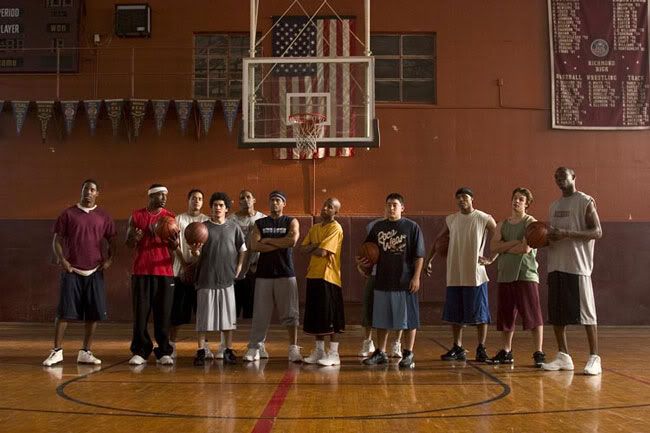
Today, athletes in America are constantly being put on a pedestal. No matter your age, sports are important to to parents, teachers, friends, coaches and family, but even more so when you have a special talent. Many movies in todays society that carry a sports theme are portrayed in a manner that is very different from real life. Basketball movies especially seem to portray certain types of people in a different light. Movies such as Coach Carter, Remember the Titans, White Men Can't Jump, and Jerry Mcguire are all movies that take real life scenarios and turn them into movies. The movie Hoop Dreams, although, is an exception to this. Hoop Dreams was originally conceived to be a 30 minute documentary about two inner-city chicago African Americans who had dreams of making it big in the NBA. The difference between Hoop Dreams and the rest of the movies I listed, is that Hoop Dreams is completely fabrication free. Movies like Coach Carter, White Men Can't Jump, and Remember the Titans are all the same. They depict a group of athletes, mostly African Americans, who dream to play their sports with great success, end up struggling to the point of almost hitting rock bottom, and then pull themselves together, work harder than ever before, and end up winning the championship and celebrating into the night. Hoop Dreams follows the same athletes, but shows their real struggles. It shows one of the boys getting kicked out of his high school because he was falling behind in class. Even though they brought him to the mostly white school to play basketball, they allowed him to fail and then kicked him out. Hoop Dreams shows the real struggle of dealing with family in hard times. Hoop Dreams follows the two stars of the movie from their beginning to their end. The two players do not end up reaching their dreams of being NBA stars, but they do both end up succeeding, which i almost think is a better message to kids then letting them watch the movies in which the protagonists always reach the 'final game' or 'make it big'. Arthur Agee from Hoop Dreams ended up launching a foundation promoting high education in the inner city where he was born, and also started a clothing line called "Hoop Dreams'. The older of the two, William Gates, played college basketball and helped Michael Jordan train at one point, but overall, did not make it big in the NBA. He instead received his Bible Degree from Moody Bible Institute in Chicago.


Friday, March 14, 2014
Gender Sports Commercial
For this post, I decided to choose a commercial shot by Nike, in which they titled "Voices"; it can be seen HERE.
I remember seeing this commercial on TV a few times, and I remember it resonated with me. Even though I am a male, the faces and voices of these female athletes and how the commercial is filmed is truly amazing. The commercial begins with close-ups of female athletes speaking directly into the camera. The four featured athletes are Joan Benoit Samuelson, an American marathon runner and Olympic gold medal winner; Marlen Esparza, an American boxer and Olympic qualifier; and finally Lisa Leslie and Diana Taurasi, both WNBA stars.
The women each begin by describing some of the hardships of playing their favorite sports and chasing their dreams. Samuelson, the marathon runner, says in the beginning "when I was growing up, girls just didn't run in public." Some of the other opening statements were "no one on my all boys team would pass to me", "Dad told me I couldn't be a boxer, he said I was too small." A few more of these hardships are stated, all while showing representations of these athletes as kids, who are in fact young girls chasing the same dreams that these women chased years ago, but in a more accepting world.
This commercial is reflecting on the many challenges female athletes had to face in past generations, but still reminds us about the challenges female athletes need to face now. These are incredible athletes who have achieved greatness in their mind and the publics. These athletes had to not only achieve greatness, but do it with backlash. These girls are reminded to "play by your own rules". The film continues with one of the athletes saying "One day I just said it doesn't matter what other people think....I'm a fashion model who can dunk...I'm a girl, that doesn't mean I have to wear a skirt". This is the girls breaking out of their shell and proving that they can do anything men can, even if they are women. It is women taking a stand, and proving that they should follow their dreams, no matter what they are. The commercial comes to an end, taking a 5 second pause in the voices to just show the images of the little girls, looking tough, brave and proud to be on the field. The last girl they show is the one representing Diana Taurasi, who touchingly says into the camera, "I just want to play ball."
I love what Nike did with the commercial. It was able to grab my attention at the very beginning hold it the whole time. This was released on the 40th anniversary of Title IX (2012) to celebrate how far women have come in pursuing their sport and following their dreams.
http://www.youtube.com/watch?v=f1ighxU1vYw
Sunday, February 16, 2014
Sport, Politics, & the Olympics
Sports have always played a role in politics, sometimes for the better, and sometimes for the worse. The Olympic games especially, because the host country has all of the power and wants to promote their country accordingly to the rest of the world. The 1936 Olympic Games, hosted by Berlin Germany were was a great example of politics overtaking sports, as these games were at the forefront of the Nazi movement. One of men put in charge of organizing the Berlin Games was under command of Hitler, so his ideologies were not the best for sport in general, but they were what Hitler wanted. For example, this man exclaimed that the games were a great way to promote sport with the German youth, but he also stated that sports were a "way to weed out the weak, Jewish, and other undesirables". Although Hitler had many plans to ban Blacks, Jews and "undesirables" from competing, the rest of the world came together and made it clear that everyone should be allowed to compete, no matter where the games are held. This notion by Hitler seems to be a foreshadowing of the next ten years for Germany and the rest of Europe. This definitely relates to the idea of a Country working to display their nationalism and beliefs onto other countries and the rest of the world in order of promoting their said beliefs. Because of this example and many, many more, I have to disagree with the statement "Sport is pure and devoid of any political interference." Often times sports is related to politics, and these olympic games are just one way. Although this example shows how politics can negatively affect sports, there were many times in which politics and sports worked together for the benefit of society. One example of this is Jackie Robinson and the Brooklyn Dodgers working to end segregation in the United States through introducing African American players to a White only Major League Baseball.
References:
-Powerpoint
-"August 1936." United States Holocaust Memorial Museum. United States Holocaust Memorial Council, n.d. Web. Feb. 2014.
References:
-Powerpoint
-"August 1936." United States Holocaust Memorial Museum. United States Holocaust Memorial Council, n.d. Web. Feb. 2014.
London Calling: The Globalization of the NFL
The article from Grantland, called "London Calling" made many claims that the NFL was looking to expand to London in the coming years. Although this may seem like a longshot because the NFL has called the United States 'home' since its genesis, the league has definitely been making moves to create a fanbase and generate interest in London. For the past few years, the NFL has been playing an exhibition game at Wembley Stadium which has always been a major success. I think it clear why the NFL has been showing interest in the city of London and working to create a fanbase there. One, there is money in move. There are millions of sports fans in London that are willing to follow the NFL if they have access to it. Although soccer would still remain the most popular sport, an involvement in the NFL would bring billions of dollars in revenue through advertisements, TV deals, games, merchandise etc. The second reason why this makes sense is because the NFL probably wants to create a more international scene. Soccer is by far the most popular international sport and will most likely remain so for some time, but NFL commissioner Roger Goodell seems to have interest in that number one spot. If American Football ever wants to branch into an international fanbase, London is definitely the city to start in. After London, I could imagine another expansion team in Mexico, maybe Mexico City.
Of course, with all of the success that would be generated by a London team, there would be barriers. Players may not want to relocate to such a distant place. Travel times are outrageous and would definitely leave one side at a disadvantage. I think at first, there would be struggles, but after a few years of more expansion and tweaks, the NFL could be ready to break the international barrier.
Reference: London Calling Article
Of course, with all of the success that would be generated by a London team, there would be barriers. Players may not want to relocate to such a distant place. Travel times are outrageous and would definitely leave one side at a disadvantage. I think at first, there would be struggles, but after a few years of more expansion and tweaks, the NFL could be ready to break the international barrier.
Reference: London Calling Article
Wednesday, January 29, 2014
Sociogenesis of Slamball
 Slamball is a sport that many people may have never heard of. Oftentimes viewed as a combination of basketball, football and gymnastics, the game involves two teams who play full contact basketball in a walled court which replaced its wood floors with high intensity trampolines. Mason Gordon, the man responsible for creating Slamball in ~2001, was recorded saying he "wanted to create a combination of sports that approximated a real-life video game". The next step for Gordon was finding players. He wanted to find players that were proficient in basketball, athletic enough to use the trampolines to their advantage, and tough enough to play in a full contact environment where crashing into other players in mid-air was part of the game. He decided to turn to the sport called "Street Basketball" to recruit players. Gordon recruited 6 Street Basketball players, taught them the game, and created its first two teams: the Los Angeles Rumble, and the Chicago Mob. The first exhibition game between these two teams took place in 2001, with the Chicago Mob winning. Soon after this game, Gordon was able to recruit more players for more teams. Within a year, over 400 players had been enlisted as potential Slamball players.
 Rules have not changed drastically since its genesis in 2001, yet the games marketing has. Early on, Gordon connected with Mike Tollin, a TV and film producer; his goal was to showcase the new sport on channels similar to Spike and Versus.
 The uniforms for the sport really evolved quickly. The picture at the top of the page shows a training session in 2002. At the time, there were no official uniforms, but only colored pennies and some pads. Looking at the sport in the next few years, you can see the uniforms have evolved into eye-catching spectacles.
 Since its genesis, the sport has hit some rough patches. Since the 2008 season, Slamball has been on a moratorium. The sport is hoping to make an official comeback in the next few years.

Friday, January 24, 2014
Sport in the Ancient World
Sport was perceived very differently by the Ancient Greek world and the Romans. The first Olympics, hosted by the Greeks in 776 BCE were an organized event where Greek men only could compete in a sprinting competition, to see who was the fastest. These men spend months training and sculpting their bodies to emulate the statues of the Gods. The Olympics, as they created them, were just as much about winning as they were paying respect to the Gods; it was an honor to be crowned victor. Later of course, the Greeks added many track and field events to the olympics, including a precursor to the shot put and weight lifting.
In Ancient Rome, of course, Gladiators were viewed as athletes of the region. Gladiators and the sport behind their name were very different in character than the Olympics. Gladiators were not idolised similar to the olympic athletes, yet they were used solely as entertainment. Instead of bathing them in specific oils and dust as ritual, they were housed in dirty, smelly chambers, only brought out to fight to their death. The whole scene of gladiators was built behind entertainment. Their fighting was entertainment for the king, and entertainment for the people. Winning did not reward some gold medal or sense of pride, yet it only allowed the gladiator to keep his life. While olympic athletes would train in specific facilities and in an organized fashion, the gladiators were trained as soldiers. They were given swords, armour, and told to fight.
In Ancient Rome, of course, Gladiators were viewed as athletes of the region. Gladiators and the sport behind their name were very different in character than the Olympics. Gladiators were not idolised similar to the olympic athletes, yet they were used solely as entertainment. Instead of bathing them in specific oils and dust as ritual, they were housed in dirty, smelly chambers, only brought out to fight to their death. The whole scene of gladiators was built behind entertainment. Their fighting was entertainment for the king, and entertainment for the people. Winning did not reward some gold medal or sense of pride, yet it only allowed the gladiator to keep his life. While olympic athletes would train in specific facilities and in an organized fashion, the gladiators were trained as soldiers. They were given swords, armour, and told to fight.
Subscribe to:
Comments (Atom)